by Ruoyu Duan
My research is informed by the experiential paradigm, which examines translation as an embodied, materially-grounded meaning-making process (Blumczynski, 2023; Campbell & Vidal, 2019, 2024; Grass, 2023; Lee, 2014, 2022; Robinson, 2017). For long, translation has been studied within the linguistic paradigm that confines the object of translation to the verbal text and the methodology of translation to the transfer of messages extracted from the verbal text. In real-life translation, even when working with texts primarily composed of words, we need to perceive the text – see it, hear it, sort it. Of course, more sensorial and affective dimensions will be involved, if we consider the “text” we translate as a concrete entity, whether as a mental construct or a physical thing, and the process of translating as something that needs to be performed rather than a purely “spiritual” form. After all, even intangible “thinking” still depends on concrete organ activities.
See
i
t
heaR
i
t
sort
i
t
Hence, with the experiential paradigm, translation is situated in reality rather than metaphysicality. Translation is examined as something we do rather than a mere representation or ideation (Campbell & Vidal, 2019, 2024). It is an experience that entangles with both our mind and body – a mind-body complex that dwells in reality with things, sentient beings, money, norms…
An experiential translation leaves traces on people and things just like what the eternal matter movement does to the world, sparing no one and nothing.
In this context, materiality, performativity and experientiality gain importance in this paradigm. The mechanism of meaning is based on the subjective, sensorial experience of the translators and on the material condition of the medium involved in the process (Haapaniemi, 2024, p. 25).
So, against this background, in this blog post I’d like to venture into the idea of the body as the site of contention for translation from two aspects. The representation of the body interests me, whether it be the poreless face of a blue-eyed female for beauty product ads on a screen several storeys high, or simply the accessories, garments, make-ups, and tattoos on people’s bodies. I have several tattoos on my own body, with a visible one on my chest that sometimes begets jokes of not being able to find a job or husband from some of my Chinese elders. They are already interpreting my body, which, in a sense, interprets me as a person of sociality and personality. A female body with tattoo is already translated by some into an “unbehaved” girl, and tattooing nonetheless, in some cases, might as well translate into the contempt for those norms. The body is never simply a natural vessel, but a canvas where people inscribe their stories, and the act of inscribing can be painful and pleasurable. It becomes a site where competing narratives and power structures clash, as individuals struggle to assert their own embodied identities against the normalizing forces of social norms and expectations.
This brings our first proposition: the body is the object of translation. Rather than being an equivalence to some truth or naturalness, the body is always represented. So basically this means the body is not JUST a body. It is a semiotic system that can be rewritten using a full semiotic repertoire and is socially configured (Vidal Claramonte, 2024, forthcoming). It is the translated text upon which meanings are inscribed, and through which those meanings are refracted and reinterpreted.
What proves to be equally interesting is the function of the body, and how people perceive such function. The classic mind-body dualism relegates the flesh to be the vessel of thoughts, whose own sensuality and carnality were regarded as burdening if not despicable. However, as humans in the flesh, we cannot get rid of our heavy bodies. (Un)fortunately, the body is not merely a conduit but the indispensable medium of experience (Wegenstein, 2010). The body, and its interaction with its immediate environment, determines how we perceive reality, which is reflected in our expression of such reality (Lee, 2014, p. 348). It is the body that engages in meaning-making. It perceives, thinks, and acts as the intermediary between the self and the world, and it is through these bodily perceptions that we make sense of the world. While it might be too hasty to conceptualize all sensing to be meaning-making, what should be emphasized is that meaning-making cannot be separated from the sensorium. Ideation is always grounded in embodiment.
Hence, this leads to our second proposition: the body is the translating agent. Translation as the core mechanism of meaning making is performed with all senses, engaging the translator’s sensorial, affective, and kinesthetic faculties (Campbell & Vidal, 2019). Here I want to further argue that, in performance art in particular, these two propositions converge. The artist creates artistic text through their bodily perception, and such perception is transformed into their artistic texts. The body is the very medium through which the translational and artistic process unfolds. It is the sensorial, experiential, and performative aspects of the body that enable the artist to engage in art-making and communicate their vision to the audience.
Ma Liuming
Next, I’ll use Ma Liuming’s works as examples to illustrate these arguments. Born in 1969, Ma Liuming is one of China’s earliest practitioners of performance art. In the 1990s, he created the Fen-Ma Liuming (芬·马六明) series. 芬 (fēn) was the name of his first girlfriend, meaning fragrance, which is also a homophone of 分, meaning separation. 芬is usually associated with feminine traits and used for female names. Ma mentioned that since childhood, he had frequently been confronted with the question whether he was a boy or a girl. At a party in 1993, he swapped clothes with some girls and posed for photos, which sparked the creation of this series.
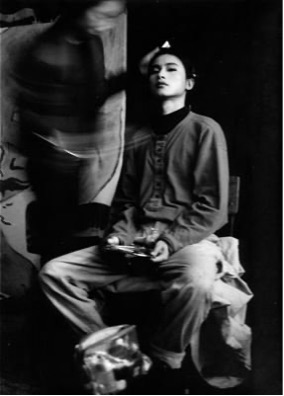
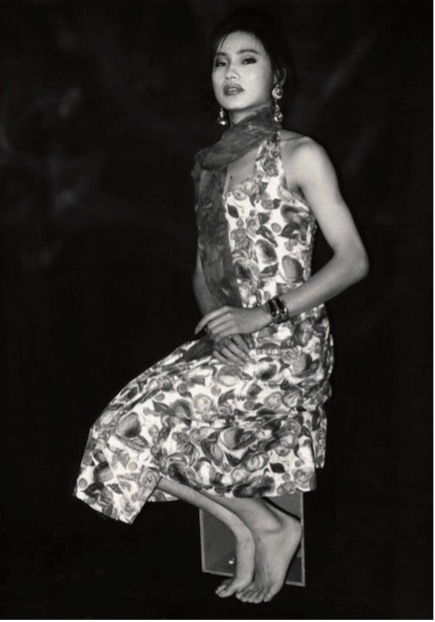
Similar to Cindy Sherman, Ma used his own body as a text to translate the situation of women. He transformed himself into 芬·马六明 who possessed female traits recognizable enough at least in the 1990s. He rewrote his body into this gendered text through a variety of non-verbal resources, such as makeup, jewellery, clothing (especially the dress), hairstyle (especially the long hair), and an elegant, even if slightly pretentious, sitting posture with his legs together rather than spread. While this may be the artist’s partial understanding of the female appearance, his multilayered rewritings nevertheless lay bare that there are so many social configurations imposed on gender normativity. Resonating with Cindy Sherman’s multilayered camouflage across space, Fen-Ma Liuming illustrates the performative nature of gender, that gender is a construct rather than something inherent (Butler, 2007/[1999]).
In some other works, Ma employed a different approach by exposing the paradoxical coexistence of a socially defined female face and a biologically defined male body. Presenting an androgynous figure, Ma Liuming asked the question “What makes a man a man and a woman a woman? Is it simply a matter of body image?” (Qian, 1999, p. 73) Interrogating the gender and boundary is centrally reflected in his work Fen-Ma at the Great Wall (1998), where the naked Fen Ma Liuming was walking on the Great Wall, a quintessential symbol and actuality of borders, dividing us from them, friends from foes. Through his performance, Ma embodied a straddling across cultural and gender boundaries.
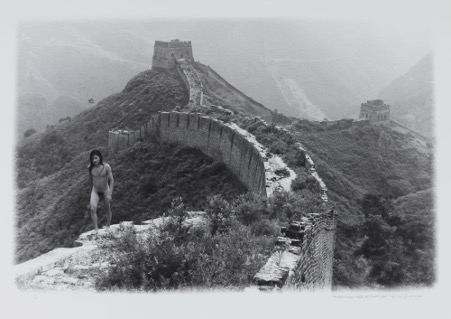
Ma’s creation of the hybrid body is akin to translingual writing, where a single language always entails heteroglossia. Ma is a hybrid writer (Vidal Claramonte, 2021), who intentionally creates a polyphonic text where different genders speak to each other. Such writing can never be realized in a monolingual paradigm that adheres to orthodoxy, but can only be accomplished through a series of translations that always crosses the boundaries, deviates from the norm and mediates differences, creating what Zhang Rui (2019) termed as the “translational artistic expression”. Such expression “can exaggerate, highlight, displace, and queer normative expectations across genders and cultures (Bermann, 2014, p. 292; cited in Campbell & Vidal, 2023, p. 24).”
Once he had decided to become a performance artist, Ma did not simply translate his body from a third-person perspective, but embodied these translations through his practice. Although Ma stated in many interviews that his works were not intended to engage in gender politics, his translational body echoes the idea of trans-embodiment (Lehner, 2022; Prosser, 1998). Trans-embodiment rejects the “truth of the visible,” or, in other words, the equivalence between seeing and knowing (Lehner, 2022). Instead, trans embodiment values “the embodied feeling as form of self-knowledge and self-articulation (ibid.).”
As Ma said in an interview in 1999, to create Fen Ma was “a process of knowing and identifying” himself (Qian, 1999, p. 73). Fen-Ma Liuming is not Ma Liuming, but a persona he created through translation. Yet, Fen Ma Liuming walks with Ma Liuming. By becoming Fen-Ma Liuming, Ma Liuming becomes himself. Such performative, embodied translation further debunks the mind-body dualism and forms a mind-body complex that foregrounds “a thinking through the body or the doing-thinking of performance practice (Maoilearca, 2020, p. 9; cited in Campbell & Vidal, 2023, p. 15).”
Zhang Huan
The “doing-thinking” approach is evident in many of Ma’s contemporaries, including Zhang Huan, another famous forerunner of performance art in China in the 1990s. For instance, in 12 Square Meters, Zhang was sitting naked in a filthy public toilet at his then neighbourhood, and covered himself in fish oil and honey which attracted flies. He experienced his endurance of such intense discomfort, which reflected the dignity of ordinary people living in harsh conditions (Gao, 2021, p. 307). As Gao Minglu notes, in the 1990s, Chinese performance art shifted towards the privatization of the body, exploring personal bodily expression amid the broad political repression (ibid., p. 306).
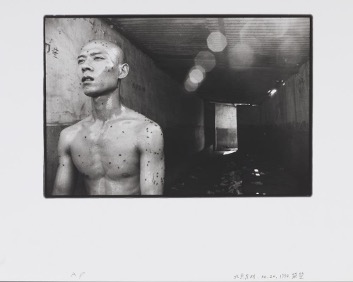
Despite the fact that many contemporary Chinese artists, including Zhang and Ma, have all gone to great lengths to avoid linking their work to politics, I still want to say a few words about the repression, which is the undertone of the era that, while not necessarily determining, cannot be filtered out. In 1994, Ma Liuming was arrested while he was performing at his own home on charges of performing a “porn show”. He was detained for two months and then released. This group of artists lived through some of China’s most turbulent yet vibrant years, including the 85’ New Wave and the brutal suppression of the national student pro-democracy movement in 1989. Today, in China, the art scene continues to face severe censorship, if not outright repression. By the early 21st century, Ma as well as Zhang have retreated from performance art.
Perhaps it is a bit dark to say, but at a time of material deprivation and stifling atmosphere, when one’s tongue and limbs were tied up, translating through the body was especially poignant, as the body became the last resort.
Examining performance art through the lens of translation foregrounds the body as a site of possibility. Situating experiential translation in the artistic domain demonstrates creative ways of transforming human bodies into powerful expressions which utilize all kinds of semiotic resources and engage with all senses and to encompass what can be communicated by the mind-body complex. Through the translational expression and embodying translation themselves, the artists can challenge gender norms and cultural boundaries, and embrace a pluralistic and evolving sense of self and art-making.
Note: All Chinese names in the text appear in the common Chinese surname-first name structure
References
Blumczynski, P. (2023). Experiencing Translationality: Material and Metaphorical Journeys. Routledge, Taylor & Francis Group.
Butler, J. (2007). Gender Trouble: Feminism and the Subversion of Identity (2nd ed). Routledge.
Campbell, M., & Vidal, R. (Eds.). (2019). Translating across Sensory and Linguistic Borders: Intersemiotic Journeys between Media. Springer International Publishing. https://doi.org/10.1007/978-3-319-97244-2
Campbell, M. & Vidal, R. (2023) On Performing Philosophy through Translation. Translation Matters, 5 (1), pp. 9-28. https://ojs.letras.up.pt/index.php/tm/article/view/13236
Campbell, M., & Vidal, R. (Eds.). (2024). The Experience of Translation: Materiality and Play in Experiential Translation. Routledge.
Gao, M. (2021). Zhongguo dang dai yi shu shi: History of Chinese Contemporary Art (1st ed.). Shanghai da xue chu ban she.
Grass, D. (2023). Translation as Creative–Critical Practice (1st ed.). Cambridge University Press. https://doi.org/10.1017/9781009075039
Haapaniemi, R. (2024). Translation as Meaning-construction under Co-textual and Contextual Constraints: A Model for a Material Approach to Translation. Translation Studies, 17(1), 20–36. https://doi.org/10.1080/14781700.2022.2147988
Lee, T. K. (2014). Translation, Materiality, Intersemioticity: Excursions in Experimental Literature. Semiotica, 2014(202). https://doi.org/10.1515/sem-2014-0044
Lee, T. K. (2022). Translation as Experimentalism: Exploring Play in Poetics (1st ed.). Cambridge University Press. https://doi.org/10.1017/9781108917292
Ma, L. (1993). Ma Liuming Exhibition [Exhibition webpage]. Beijing Art Now Gallery. Retrieved from http://www.beijingartnow.com/CnExh_Details.aspx?id=79&model=ew
Ma, L. (1993). Fen Ma Liuming [Photograph]. Artsy. Retrieved from https://www.artsy.net/artwork/ma-liuming-fen-ma-liuming
Ma, L. (1998). Fen–Ma Liuming Walks the Great Wall [Photograph]. M+ Sigg Collection. Retrieved from https://www.mplus.org.hk/en/collection/objects/fenma-liuming-walks-the-great-wall-2012720/
Lehner, A. (2022). Beyond Representation: Trans Embodied Methodologies. Dilettante Army. https://dilettantearmy.com/articles/beyond-representation
Prosser, J. (1998). Second Skins: The Body Narratives of Transsexuality. Columbia University Press.
Qian, Z. (1999). Performing Bodies: Zhang Huan, Ma Liuming, and Performance Art in China. Art Journal, 58(2), 60–81. https://doi.org/10.1080/00043249.1999.10791940
Robinson, D. (2017). Translationality: Essays in the Translational-medical Humanities. Routledge, Taylor & Francis Group.
Rong, R. (1993). East Village, Beijing, No.20 [Photograph]. M+ Sigg. Retrieved from https://www.mplus.org.hk/en/collection/objects/east-village-beijing-no20-2012857/
Vidal Claramonte, M. C. Á. (2021). Traducción y literatura translingüe: Voces latinas en Estados Unidos. Iberoamericana Vervuert.
Vidal Claramonte, M. C. Á. (Forthcoming). In Vidal, R. & Campbell, M. (Eds.), The Translation of Experience: Cultural Artefacts in Experiential Translation. Routledge.
Wegenstein, B. (2010). Body. In W. J. T. Mitchell & M. B. N. Hansen (Eds.), Critical Terms for Media Studies (pp. 19–34). The University of Chicago Press.
Zhang, R. (2019). Visualizing Translation in Contemporary Chinese Art: Transcultural Practices of Gu Wenda and Xu Bing = Zhongguo dang dai yi shu zhong de fan yi shi shi jie biao shu : Gu Wenda yu Xu Bing de wen hua shi jian yan jiu (p. 991044122096503414) [Doctor of Philosophy, The University of Hong Kong]. https://doi.org/10.5353/th_991044122096503414

