by Ricarda Vidal and Madeleine Campbell
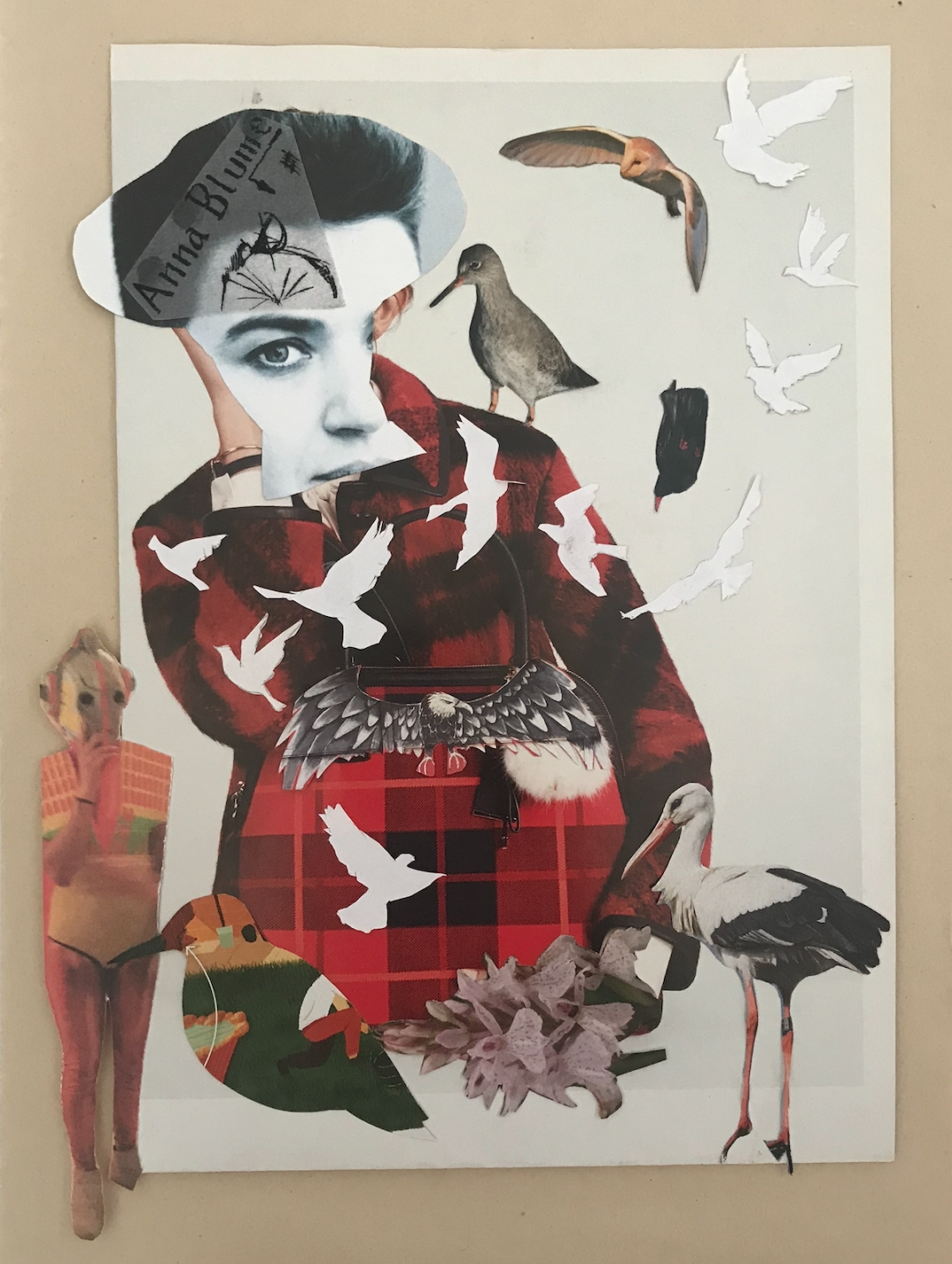
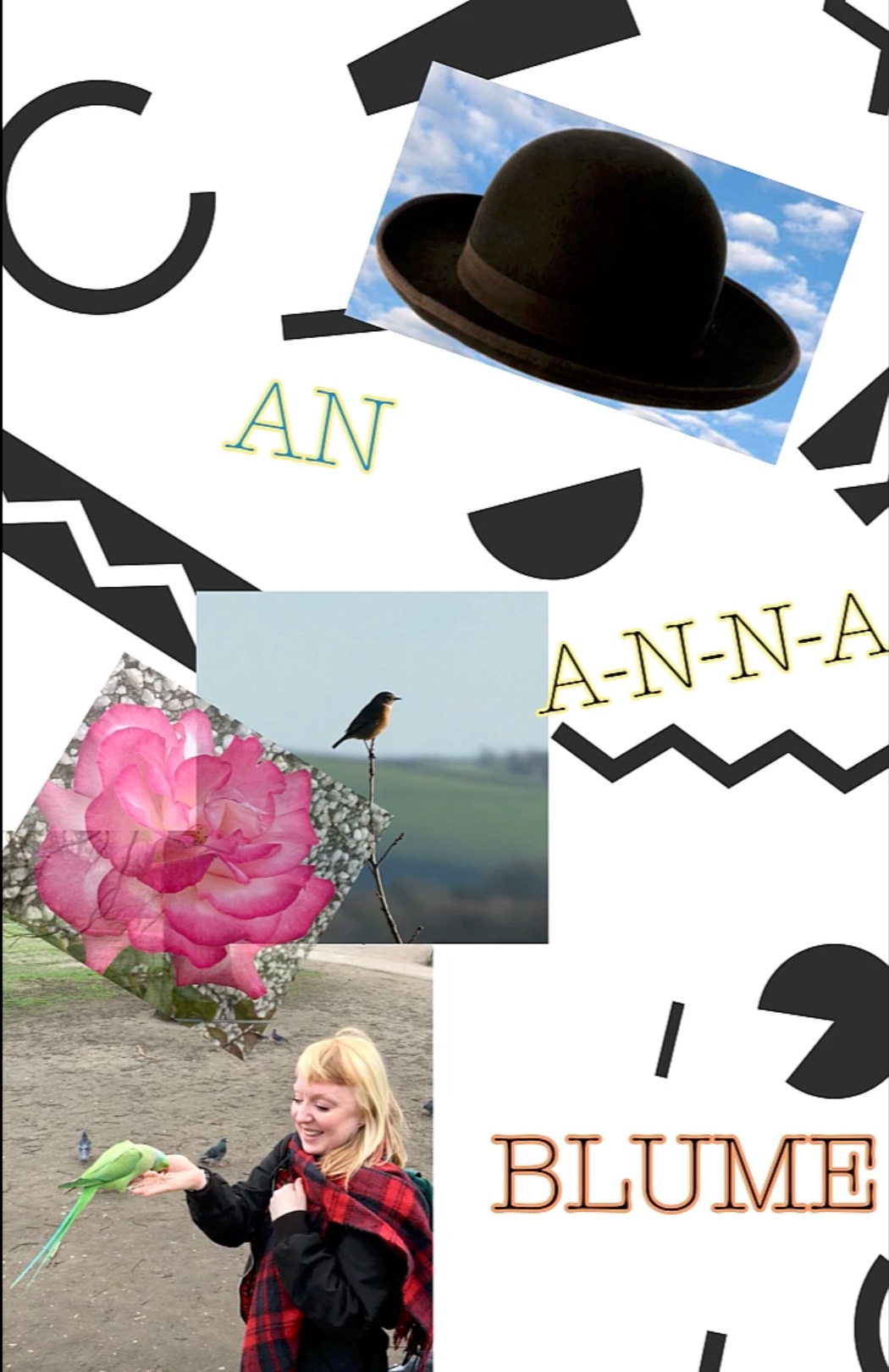
Two years ago, in spring and summer 2022, we (Madeleine and Ricarda) jointly translated Kurt Schwitters’ poem “An Anna Blume” (1919) into a multimodal work. We made collages of paper, cardboard, wood, drawing, fat, sound, photography, film, stop-motion animation… and used the tools offered by digitality to create the audiovisual version of the poem, which we want to share with you on this blog today.
We have written about the translation process in an article published in Translation Matters in July 2023, but today we want to talk a bit about the after-effects of this translation, the way Anna Blume has become part of our lives… and the way a translation is never finished.
Ricarda:
For me, springtime is the time of Anna Blume. She is most present when the town where I live resonates with the sound of collared doves calling their hoo hoooo hoo from the roof tops and the fat wood pigeons crash land in the cherry tree behind my house. The gardens are abuzz with bees and the high-pitched whistle of starlings. Tits of all kinds flit between the bushes and the song thrush warbles from across the woods. Flowers and blossoms everywhere. We used many of those sounds, images and smells in our translation. I deliberately sought out the flowers and blossoms, the buzz of the bees when I was looking for Anna Blume, Eve Blossom, Ana Flor (or her male alta ego Rolf Ana, who stayed hidden). The birds were always there, on every recording, on purpose or inadvertently. Anna Blume, after all, hat ein Vogel, has a bird, is off her tits, has a falcon, has a good time with the falconer… That idiomatic bird, which disappears in most translations of the poem, had an irresistible pull. We needed to find out more about it and make space for it in our translation. And so, when spring comes, my small seaside town echoes with the birds’ call, hoo hoo Anna Blu-hoo-me, twee tweet tweve blossom…
An Anna Blume, that poem, which was first exposed to the elements on posters pinned to lamp posts around the streets of Hannover more than a century ago, has become a nature poem. Anna Blume, urban socialite, is gallivanting round the back alleys of small-town Britain… maybe a bit like Kurt Schwitters in the Lake District, exiled later in life, where Anna becomes Eve and the Merzbau is revived in an old barn.
Madeleine:
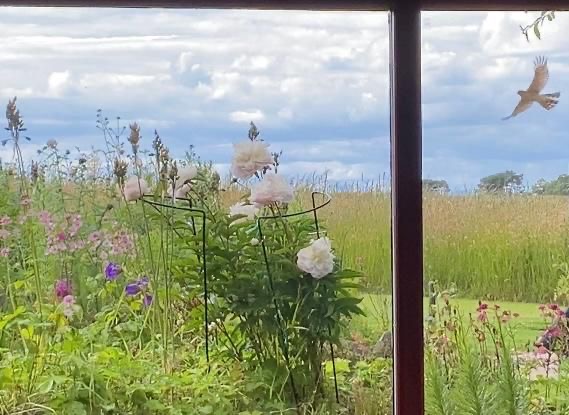
Spring comes later in Scotland, and our film collage is part of a continuing process to which many have contributed over the seasons since Schwitters first published An Anna Blume. In a sense I am always getting to know An Anna Blume, translating and retranslating her, and inviting others to do so. After co-creating our translation, we filmed a dance-based translation, choreographed and performed by Tricia Anderson. It was a windy day in early July, the garden swaying with camassias and blushing aconites—Anna Blume picking her way amongst white peonies, holding on to her hat lest it should fly off with the bird in her head. (Schwitters’ Anna Blume wore her hat on her feet, perhaps it was windy then too.) A still of this film revealed a sparrowhawk we hadn’t seen, caught hovering in mid-air—a chance artefact, the gift of a glitch, oddly germane to our quasi homophonic translation of Schwitters’ verse ‘Anna Blume hat ein Vogel’ to ‘Anna Blume had a falcon’.
I like to think of our co-translations, but also all prior translations as well as those embodied by participants in our Anna Blume workshops in London (2022) and Łodz (2023), and those yet to emerge, as a collective homage to Kurt Schwitters’ vision for a Gesamtkunstwerk. A total work of art dispersed in time and space, each new translator prenant la relève with a fresh take on Schwitters’ futurist vision of the wench or Frauenzimmer that was Anna Blume, ‘beloved of [his] twenty-seven senses’; each translation a ‘drippest beast’, eschewing any movement that would claim her as their own.
We hope you enjoy the film and if you would like to share any translations of your own with us, please get in touch, or, better still, visit our padlet and add it to the growing number of Annas, Eves, blossoms, flowers, birds and beasts.

