by Karen Bennett
In this contribution to the ETN blog, Karen Bennett offers an intriguing look inside her new book, Translationality in Music, which was published by Routledge this summer.
Book Launch: The book was launched with a roundtable discussion at the Experiential Translation Online Seminar on 9th October 2026. Watch a recording.
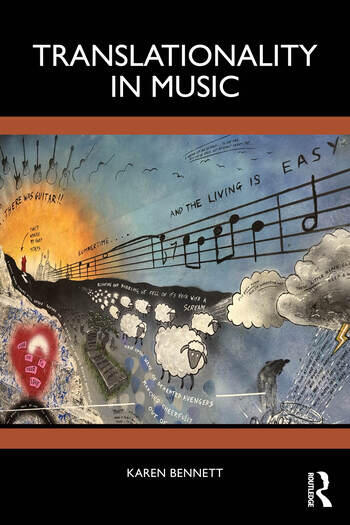
This is a book about music, more specifically about the experience of music. It is about the physical experience of expressing sounds through an instrument, whether we embrace it in our arms like a lover, caress it with our fingertips, pummel it like an enemy or breathe life into it from the depths of our being; and about the creative excitement of interpreting a piece that may have been composed centuries before or of improvising around a familiar theme in an informal jam session. It is about the very different cognitive experiences involved in reading written music as opposed to playing by ear; and also about the more passive experience of listening to music, and the way it affects our body in different ways, depending on whether we are hearing jazz in a pub, Mozart in a concert hall, or hip-hop at home in our bedroom with headphones.
But it is also a book about translation, more precisely, about the translational processes involved in all the experiences listed above. For if we consider that music is a fleeting artform, one that is auditory in nature and unfolds in time, it becomes clear that the process of communicating it to others, whether live or via manuscripts or recordings, implies multiple acts of translation involving different codes and media.
The performer that is reading from sheet music is decoding back into the medium of sound something that has previously been intersemiotically translated into written signs (dots on a stave), which she has received visually, through her eyes, rather than her ears. However, the process is not direct. Whatever the instrument (and the quality of the music will of course be different depending on what instruments are involved), the dots on the stave will have to be interpreted first through the body – by the placing of hands or bow, the tightness of the embouchure, the force of breath – before the music can re-emerge as soundwaves to be received by the listener through their ears.
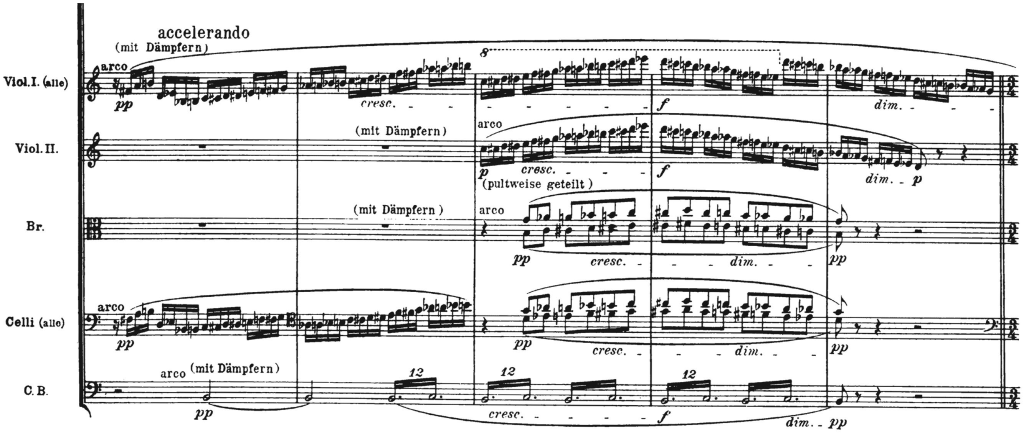
Adolph Fürstner, 1905, p. 136) – Fig. 6.2 of Translationality in Music
The conductor of an orchestra also translates when she interprets a composer’s idea of his symphony into a tangible version that is different from any that have come before. She mediates between the score and the players, coaxing the various voices into a coherent whole that transmits new musical perspectives, and perhaps new emotions, in relation to those initially contemplated by the composer. In the rehearsals, she may use verbal language to transmit her interpretation to the players; but once the orchestra has been primed and is up on stage in the concert hall before an expectant audience, it is the conductor’s body language that does the translating, waving, bowing and gesturing at different amplitudes and speeds in accordance with the precise musical meaning that she wishes the orchestra to convey.
The act of arranging a piece for a new purpose or lineup is also an act of translation, analogous in all respects to the translation of a literary work. The basic melody and chord sequences may be maintained but are distributed across different instruments to those initially contemplated by the composer, perhaps accompanied by changes of tempo, rhythm and dynamics that give it a whole new feel whilst still being recognisably the same piece. The production of a cover version in the realm of popular music is another case. And the more attention we pay to how musical motifs and forms transit from one version to another, reappearing in new compositions as quotations or motifs, we begin to realise that nothing is ever truly original. Whether we are discussing the trajectory of Western art music (that which is rather inaccurately termed ‘classical’ music outside its sphere), jazz, electronic sampling or the (sometimes very different) musical traditions of other cultures, it is fair to assert, along with Parmenides and King Lear, that ‘nothing comes from nothing’. That is to say, in music, as all other aspects of culture, the new is always modelled on the old in a translational process that has no beginning nor end but stretches back into the depths of time, and forward into the unforeseeable future.
This book is structured rather like a rhetorical antithesis in the sense that the second half apparently contradicts the first. Part I (Nothing comes from nothing) explores the idea, central to the translationality paradigm, that nothing is original, or ‘everything is a remix’ as Kirby Ferguson (2012) puts it – in other words, that all cultural production, including music, is ultimately based on something that went before. The argument is built thematically by focusing on different aspects of musical translationality in turn. Chapter 1 focuses on the act of Interpreting Music, which is assimilated to verbal translation on the grounds that, in many languages, the process is conceptualized in the same way. The point is made that the Western musician working from a written score will be faced with much the same dilemma as that facing the translator of the written text – whether to adhere as closely as possible to the score on the understanding that her remit is to materialize or reproduce the composer’s intention, or to interpret the piece in her own way to give voice to a subjective response – and that, like interlingual translation, the decision is always mixed up with important questions of power and authority.
Chapter 2 (Translational Layering) turns to the various acts of translation that are implicit in the production of musical works in the Western art tradition (the transcription of composers’ autograph manuscripts, the editing of scores, and procedures downstream, such as musical arrangement, orchestration and adaptation), taking as a case study Rameau’s famous keyboard piece Les Sauvages (1725).
Chapter 3 (Playing by Ear) begins with an encounter, already described in Chapter 2, between sophisticated Europeans and the indigenous music of the Amerindians, which took place in Paris in 1725, and proceeds from there to a more general reflection about the translational implications of playing by ear, considering first the translational mechanisms involved in the Amerindian music tradition, before moving on to discuss Western jazz improvisation. Does a melody remain the same when it is transposed from one key to another? What are the mechanisms underpinning musical improvisation? And what were the translational processes involved when the music of the African savannah* was carried to America on the slave ships and mixed with the local music there to give rise to jazz?
* For a debate on where in Africa the music originated that ultimately blended with American popular music to form jazz see for example Tony Palmer, All You Need Is Love: The Story of Popular Music (1976) or M.C: Gridley, Jazz Styles: History and Analysis (2009).
Chapter 4 (Covers and Remixes) continues the story of Western popular music following the shift, in the 1940s and 50s, to a new paradigm, brought about by technology. With the appearance of sound recording, the cover version and remix emerge as the translational forms par excellence, bringing important implications for copyright – a law which is of course designed to protect ‘original’ works of authorship from unauthorized copying.
Part II (How newness enters the world) strikes off in a different direction by suggesting that, after all, some injection of originality is necessary to prevent musical culture from becoming stuck in an endless spiral of self-recycling (something that is looking increasingly likely since the advent of generative AI). The quotation from Homi Bhabha that titles the section offers the key to the reconciliation of the two opposing propositions that structure this book, suggesting that it is precisely the rewriting of musical works under new semiotic and sociopolitical conditions that enables new musical forms and genres to appear.
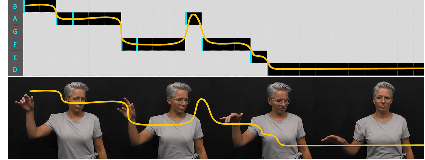
Spatial representation of the melodic line in Mirjam Stolk’s embodiment of This is Me—Greatest Showman (2020). (A) shows a spatial visualization of the melodic line – height placement represents the note (as on a musical score), width represents time, progressing from left to right, onset of a new piano keypress indicated by a vertical line. (B) shows the melodic line represented by movements of the right hand over time. Source: Fisher (2021: 14)
– Fig. 7.2 of Translationality in Music
Chapter 5 (The Nature of Musical Meaning) begins by exploring how meaning is generated within the musical system, suggesting that music acquires its signifying potential primarily (though not exclusively) through its associations with the human body. Chapter 6 (Music Translates) begins by discussing how the rich signifying code developed by composers in the Romantic period has been used to represent the extramusical world in tone poems, ballet and opera, and how these techniques were later adapted for use in cinematographic contexts, before being decisively challenged in contemporary experiments.
Chapter 7 (Music Translated) is concerned with the reverse process, how music can be reconstrued in other sign-systems for artistic or assistive purposes. It begins with a discussion of sign-singing and embodied song, before moving on to look at translations of music into visual art, architecture and literature. Special attention is given to the insights acquired on the experimental course Soundscapes: Translating from Music, organised in 2022 under the auspices of the Experiential Translation Network, concerning the translational potential offered by cross-modal correspondences.

Source: Fondation Le Corbusier.
Fig. 7.5 of Translationality in Music
The conclusion ends on a more theoretical note, drawing on research in grounded cognition to reinforce its point that music is an essentially embodied art which plays an important role in our psychosocial wellbeing. It argues that, although all the forms of musical translationality described in this book can now be performed by the machine as well as or even better than by humans, this is unlikely to satisfy the most deep-rooted emotional and physical needs that music developed precisely to fulfil.


One thought on “Translationality in Music”