Below is a list of books published by Network members relevant to experiential translation.
NEW:
R. Vidal and Campbell, M. (eds) 2025, The Translation of Experience: Cultural Artefacts in Experiential Translation. Routledge
Open Access
Experience is a multilayered, cumulative affair with transformation at its core. Its study, a necessary first step for its translation, requires an exploration of embodiment, the senses, and cultural and social environments.
The second of two volumes, this book explores how artefacts, as outcomes of experience brought about by the “artistranslator” perform…


Campbell, M. and R. Vidal (eds) 2024, The Experience of Translation: Materiality and Play in Experiential Translation. Routledge.
Open Access
Campbell, Vidal and their contributors expand the notion of translation beyond linguistic, modal and medial borders to embrace posthumanist perspectives through a holistic experiential epistemology which envisions translation as engaged, situated social practice.
The first of two volumes, this book focuses on questions of materiality and play….
Book Endorsement :
“This volume breaks new grounds by interrogating translation theory with experimental aesthetics. Its novel concept of experiential translation is set to open up new avenues of research at the intersections of language, multimodality, and contemporary art.”
Prof. Tong King Lee, School of English, University of Hong Kong.
Karen Bennett, ed. Translation Matters: Special Issue: Experiential Translation Vol. 5 No. 1 (2023)
Open Access
This Special Issue, edited by Karen Bennett, includes some of the papers presented at the Experiential Translation conference at King’s College London (July 2022), and subsequently developed into articles, alongside others which were sourced through an open call.

Tong King Lee. Translation as Experimentalism: Exploring Play in Poetics. Cambridge University Press: 2022 – Open Access
This book argues for a perspective on literary translation based around the idea of ludification, using concrete poetry as a test case. Unlike rational-scientific models of translating, ludic translation downplays the linear transmission of meaning from one language into another. It foregrounds instead the open-ended, ergodic nature of translation, where the translator engages with and responds to an original work in an experimental and experiential manner. Focusing on memes rather than signs, ludic translation challenges us to adopt an oblique lens on literary texts and deploy verbal as well as nonverbal resources to add value to an original work. …
África Vidal Claramonte. Translation and Contemporary Art: Transdisciplinary Encounters, Routledge. 2022
This book looks to expand the definition of translation in line with Susan Bassnett and David Johnston’s notion of the “outward turn”, applying this perspective to contemporary art to broaden the scope of how we understand translation in today’s global multisemiotic world. The book takes as its point of departure the idea that texts are comprised of not only words but other semiotic systems and therefore expanding our notions of both language and translation can better equip us to translate stories told via non-traditional means in novel ways. While the “outward turn” …
Translation Matters
journal; editor: Karen Bennett
Open Access
Translation Matters is a peer-reviewed online journal published by the Centre for English, Translation and Anglo-Portuguese Studies (CETAPS) of the Faculty of Humanities and Social Sciences, Nova University of Lisbon. It explores all aspects of translation, including descriptive studies of translated texts in different languages, periods, cultures and media; theoretical articles about translational issues; papers relating to the practice of translation in different domains (technical, pragmatic, literary, scientific, legal, audiovisual etc), interpreting, translator training and translation pedagogy, research methods in Translation Studies and translation technology.
- Special issue on Translation under Dictatorships (Vol. 2.2, Autumn 2020)
- Special issue on Intersemiotic Translation and Multimodality (Vol. 1.2., Autumn 2019)
Madeleine Campbell & Ricarda Vidal (eds), Translating across Sensory and Linguistic Borders: Intersemiotic Journeys Between MediaI. Palgrave, 2019
This book analyses intersemiotic translation, where the translator works across sign systems and cultural boundaries. It examines how a poem may be expressed as dance, a short story as an olfactory experience, or a film as a painting. This emergent process opens up a myriad of synaesthetic possibilities for both translator and target audience to experience form and sense beyond the limitations of words…
“a most original contribution to the field of translation and intermedial poetics” (Vasiliki Kolocotroni)

Manuela Perteghella and Ricarda Vidal, Home on the Move: Two Poems go on a Journey. Parthian, 2019
Home on the Move presents the results of a journey through Europe undertaken by two poems about ‘home’: During their journey, the poems were translated by literary translators and local film artists. The poems and their literary and artistic translations toured England in summer 2018 and were translated into new poetry in English and other languages in a series of workshops. A selection of these retranslations is also included in Home on the Move.
> Parthian Press
“One of the most inventive and necessary poetry projects of recent years”
(Chris McCabe)
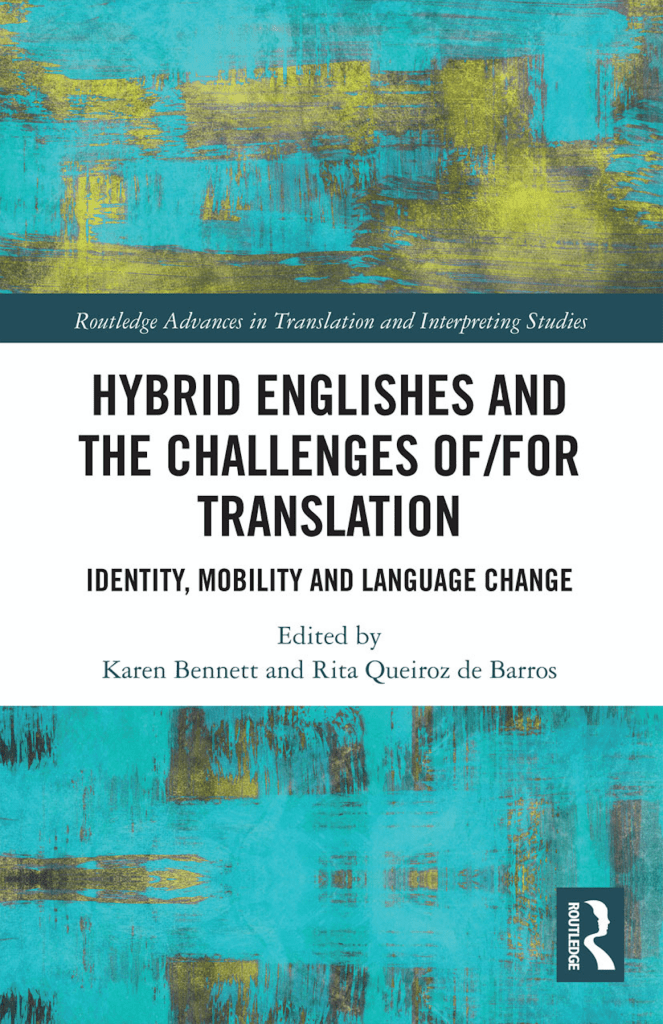
Karen Bennett and Rita Queiroz de Barros (eds). Hybrid Englishes and the Challenges of/for Translation, Routledge. 2019
This volume problematizes the concept and practice of translation in an interconnected world in which English, despite its hegemonic status, can no longer be considered a coherent unified entity but rather a mobile resource subject to various kinds of hybridization. Drawing upon recent work in the domains of translation studies, literary studies and (socio-)linguistics, it explores the centrality of translation as both a trope for the analysis of contemporary transcultural dynamics and as a concrete communication practice in the globalized world.
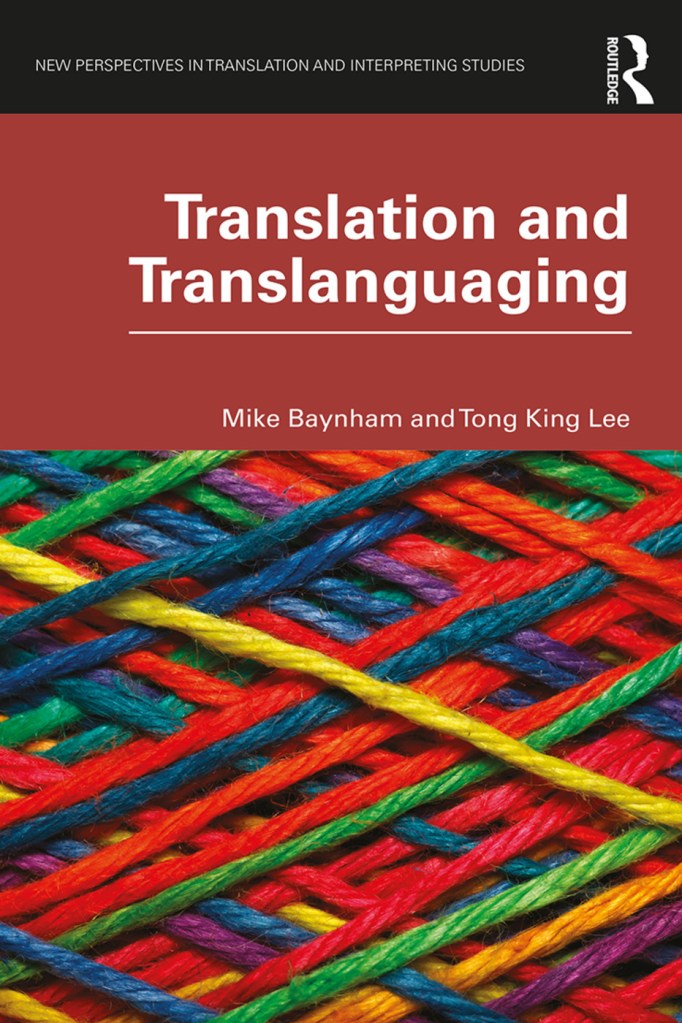
Tong King Lee and Mike Baynham, Translation and Translanguaging. Routledge, 2019
This book extends the linguistic focus to consider translanguaging and translation in tandem – across languages, language varieties, registers, and discourses, and in a diverse range of contexts: everyday multilingual settings involving community interpreting and cultural brokering, embodied interaction in sports, text-based commodities, and multimodal experimental poetics.
“Essential reading for all those interested in researching across languages and cultures.”
(Charles Forsdick)
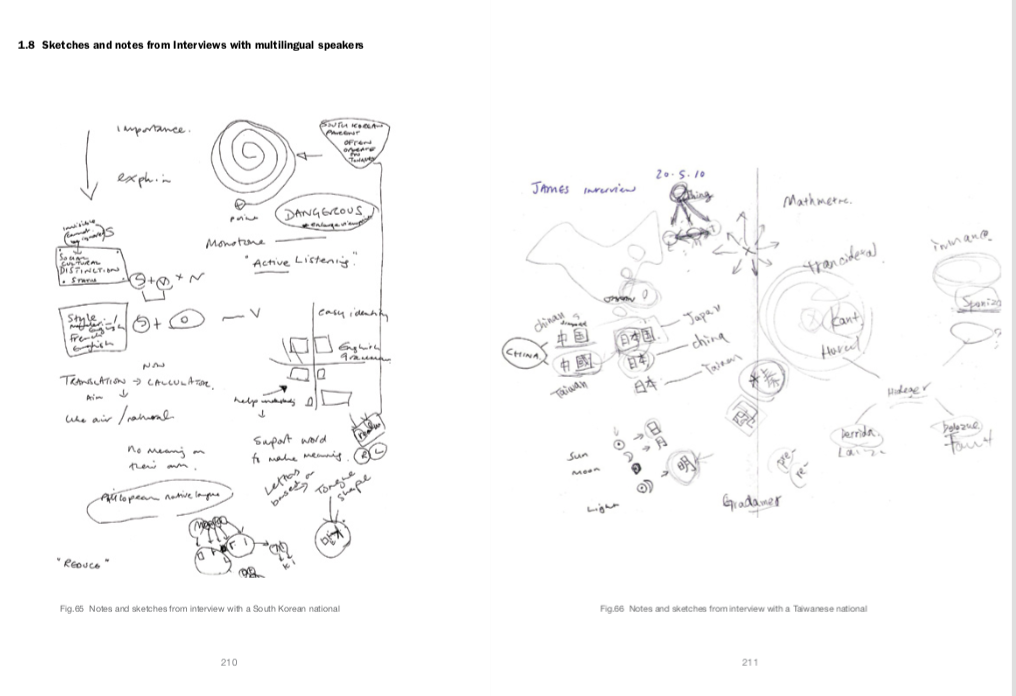
Heather Connelly, Speaking through the voice of Another – How can art practice be used to provoke new ways of thinking about the transformations and transitions that happen ‘in’ linguistic translation?Practice-based PhD thesis (Fine Art), Loughborough University depository, 2015
Speaking through the voice of another is a practice-based PhD that employs art practice to interrogate translation (as a textual and verbal practice). It uses linguistic translation as both the subject and the method to make multimedia artworks (text, sound, performance and events) that examine and analyse the translation process itself.


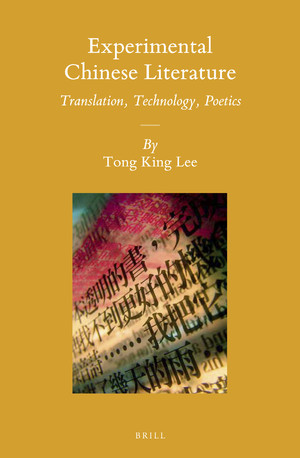
Tong King Lee, Experimental Chinese Literature: Translation, Technology, Poetics.
Brill, 2015
This is a theoretical account of material poetics from the dual perspectives of translation and technology. Focusing on a range of works by contemporary Chinese authors including Hsia Yü, Chen Li, and Xu Bing, the book explores how experimental writers engage their readers in multimodal reading experiences by turning translation into a method and by exploiting various technologies.
“A clear and wide-ranging exposition of these issues in the Chinese-language context”
(Adam Jaworski)
 Experiential Translation